The 10 Books Series - General Non-fiction

Heavier Than Heaven - Charles R. Cross
Generally speaking, I don't enjoy non-fiction as much as I enjoy fiction. In fact, early in my undergrad, it wouldn't be out of place to hear me say that I hated non-fiction. Kudos to me for at least picking the right major? I went through a brief period of time where I was somewhat enamored with music, and Nirvana, and Curt Cobain specifically. As luck would have it, this book changed my opinion of non-fiction. Perhaps it was because Cobain's story was so painful that it seemed like fiction? If you like a well-written biography, and/or feel like suffering, read this book.
 
A Heartbreaking Work of Staggering Genius - Dave Eggers
I noticed this book on shelves for many years before actually buying a copy. Lo and behold, Eggers' book ended up being one of my absolute favourites--perhaps even top five. This is an excellent book to read if you are reluctant to read biography, because Eggers' life is so wonky that it doesn't seem real. Twenty-something Eggers ends up with custody of his younger brother after both parents have died. I appreciated his unique approach to writing, and the fact that he doesn't make extra attempts to be serious about serious things. This is an absolute must-read for twenty-somethings.


A Circle of Quiet - Madeleine L'Engle
I've enjoyed L'Engle's children's fiction for some time, and then finally started reading her non-fiction works. This book, the first in a series of journals, was an absolute delight. I felt like I sat down with L'Engle for a cup of tea, and--three pots of tea later--I understood a huge portion of her life story. L'Engle has a wonderful way of putting sentences together, and this book inspired me to work harder to write my life out. L'Engle writes about her relatively unremarkable life so that it feels infinitely more important the biography of some great figure of history. This is a truly beautiful work of non-fiction.


Daughter of Destiny - Benazir Bhutto
Benazir Bhutto's life reads a lot like a Shakespearean tragedy, full of complicated relationships, corruption, and murder. The sad part about this book is that it is not Shakespeare, and is certainly not fiction. Bhutto was the first woman in Pakistan to lead a political party, and the first female Prime Minister of Pakistan; she was assassinated in late 2007. Reading this book involved a fair amount of suppressed tears over a long road trip. Even if you have zero interest in Pakistan, or women in leadership, this is a book worth reading simply to be inspired to make change.

I became vaguely aware of and then instantly fascinated by Ellen Johnson Sirleaf while taking an Engendered History class during my undergrad. Like the dedicated bookworm that I am, every time I was in a bookstore, I searched for books by EJS. I waited impatiently until this book appeared. EJS is the president of Liberia, and is the first elected female head of state in Africa. She also recently received the Nobel Peace Prize. If you lack reading time, a reasonable substitute would be to watch Pray The Devil Back to Hell, a documentary about the women's peace movement in Liberia.


 Payback - Margaret Atwood
I have mixed feelings about Margaret Atwood's writing: some of her books I love; others, I feel so-so about. Thankfully, Payback is one of the Atwood books I can sing praises of confidently. I read it largely because it was a CBC Massey Lecture, which resulted in Atwood speaking on the Massey tour that stopped in Vancouver. I tried to forget that this book dealt with (gasp) economic issues. Aside from the fact that this book was quite prophetic (in that it somewhat predicted the recent recession), it is the perfect book for those of who feel more comfortable with words than numbers.
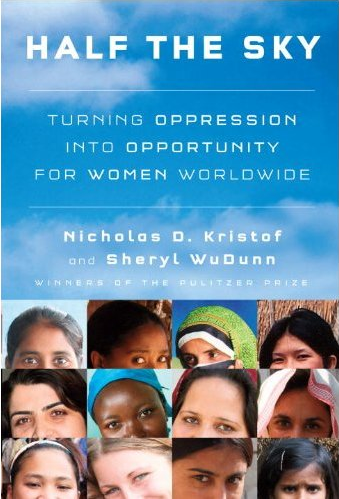

Half the Sky - Nicholas D. Kristoff and Sheryl WuDunn
I made the mistake of reading this book while I was substitute teaching. Fingers crossed those students didn't see my eyes watering. Half the Sky is a book that I ended up having many lengthy coffee dates discussing, because there was just so much to talk about. In retrospect (and with a few more years of life experience), I realize that this book is a bit broad because it touches on so many issues around women's oppression; however, it is still an excellent read. I'm also excited to watch the recent PBS documentary!


Feminism is for Everybody - bell hooks
Not-so-feminist friends, please bear with me on this one, because you really should read this book. If there is ever a book about feminism that really is for everybody, it is certainly this one. Feminism is for Everybody is an excellent primer to the cultural history of feminism, but in the most delightfully basic terms. Granted, by the time I read this book, I felt fairly aware of feminism's basic tenets, but it was a valuable read nonetheless. It's a short book, and it certainly doesn't take a lot of mental prowess to understand, which I think feminism could be well served by.


The Purity Myth - Jessica Valenti
Once upon a time, I started reading a blog called Feministing. It can be a bit extreme, but is well-informed and snarky; two things that are very important to me. It was also founded by Valenti, who wrote this book. It deals with the notion of purity (largely in American culture), and how it can actually be more damaging to young women than helpful. Though this book is a little left-of-centre for my ideologies, I also found it really illuminating as someone who considers herself a Christian.

Tuesdays with Morrie - Mitch Albom
One of my days substitute teaching found me in the classroom of a (thank you Jesus) fellow English teacher. As luck (or perhaps misfortune) would have it, I ended up staying in the aforementioned classroom for a solid week, many thanks to the H1N1 virus. I got to teach Steinbeck to young teens that didn't understand it, and Albom to older teens that had yet to experience loss. Tuesdays with Morrie is a great hybrid between biography and philosophy, and is still a short enough book to enjoy in a few brief sittings.

--- chRistie
 
PS: Books listed = in no particular order (not even alphabetical).

The 10 Books Series - Books for Kids

(Disclaimer: When I say "kids", I mean somewhere between the ages of 7 and 12.)

Harry Potter and the Philosopher's Stone - J.K. Rowling
I included the entire Harry Potter series in my previous post about YA lit. I'm sure that seven-year-old me would have been able to read the whole series, but would have been slightly terrified, well, all the time. Hence listing just the first book for this post. I started reading the series when I was only slightly older than Harry Potter himself, which was part of why I enjoyed the books so much.  I'm really excited to pass this book onto my offspring of a far, distant future. HPatPS does an excellent job of capturing the typical experience of preteens in a magical setting.

Percy Jackson and the Lightning Thief - Rick Riordan
Sometime in my early days as a bookstore employee, I stumbled upon Rick Riordan's first series. Percy Jackson and the Olympians had the unfortunate luck of following shortly after Harry Potter, and thus appears to be a somewhat similar story. What is different about these books, however, is that they deal exclusively with Greek mythology. I have always loved mythology, so these books appealed to me straight away. Interestingly, Riordan wrote these books primarily for his son, to normalize ADHD (and also making typical ADHD qualities something to be celebrated).

Into the Land of the Unicorns - Bruce Coville
I have always loved fantasy stories. I collected unicorn figurines when I was a child (and God bless my Mom for keeping them). I read this book so many times that I had most of it memorized (and could likely still complete the story in fill-in-the-blanks format). My greatest annoyance as a child was that Coville subtitled this book as "Book One of The Unicorn Chronicles", and never wrote a second book! Thankfully, sometime in my late teens, he started writing again and finished the final three books of the series. The opening sequence of the story is quite delightful.

The Chronicles of Narnia - C.S. Lewis
I was a little late to the Narnia party, considering I read The Lord of the Rings far before I knew The Chronicles of Narnia even existed. Nevertheless, I think this is an excellent series for children of all ages, especially if you manage to acquire one of the illustrated versions (which I am fortunate enough to have, thanks to very generous parents). This series has the benefit of being long enough to keep kids reading, but has enough diversity to maintain interest. Were I to pick a favourite, it would likely be (oh-so-predictably) The Lion, the Witch and the Wardrobe.

The Witches - Roald Dahl
I imagine that most people of my generation read at least some Roald Dahl when they were kids. I read Charlie and the Chocolate Factory in second grade, and vividly remember writing journals from the perspective of gum-chewing Violet Beauregarde for my language arts class. All of Roald Dahl's books are quite wonderful, and are surprisingly still amusing to read as an adult. The Witches was always one of my favourites, perhaps because not many stories involve boys being turned into mice by witches.
A Wrinkle in Time quintet - Madeleine L'Engle
This series, not unlike Harry Potter, is also appropriate for teen readers. I read this series sometime during high school, and then re-read parts of the series for a children's literature class during my undergrad. I find L'Engle's writing more fascinating by the day, simply because her approach to spirituality is so encouraging. The Time quintet is fairly unique as book series' go, considering it perhaps lends itself more to sci-fi than fantasy. As an aside, some of the earlier cover art is just plain weird. Thank you, 1970s; thank you very much.

Hatchet - Gary Paulsen
This was required reading for one of my language arts classes in early middle school, and I thoroughly enjoyed it. Reading about the unlikely plane crash and subsequent survival process of young Brian was a great alternative to all the fantasy I had been reading without sacrificing any of the adventure. I recently realized that Hatchet is the first book of five in a series, which is encouraging when most books for kids tend to be fantasy and/or sci-fi rather than (at least somewhat) realistic. Hatchet is a great book for young boys, or for any child who likes the outdoors.

The Boxcar Children series - Gertrude Chandler Warner
Not unlike The Baby-Sitter's Club, this series has a seemingly infinite number of installments, which is excellent news for young readers who read extremely fast. The fact that this series was originally published in the early 1920s speaks pretty highly of the story. I admit that I don't recall any particular details about the series, aside from the fact that I loved it as a young child. Thankfully, this is a series that children of any gender will enjoy, which is the major downfall of other series' such as The Baby-Sitters Club.

Number the Stars - Lois Lowry
Reading this book resulted in middle school me reading a lot of historical fiction. At this point in my life, I definitely didn't possess much knowledge about the holocaust (though, thanks to my Dad, I knew plenty about the first and second world wars), so Number the Stars was pretty enlightening. It is, of course, a heartbreaking book, but does an excellent job of introducing young readers to an important but painful part of history. This was another book I read as part of a language arts class, so many kids will read it in school (and for good reason).

The Baby-Sitter's Club series - Ann M. Martin
One Christmas, my parents bought me a copy of Kristy and the Copycat (which happens to be the seventy-fourth book in the series). I was so excited to get my hands on a book about someone who shared my name, albeit spelled incorrectly. Soon thereafter, my Mom arranged with another friend's Mom to buy someone's entire collection of BSC books, which we shared ownership of. I absolutely loved these books, and I am so happy that the series is being reprinted to be more appropriate for 2012 readers (aka: pagers are replaced with cell phones).

--- chRistie

PS: Books listed = in no particular order (not even alphabetical).

The 10 Books Series - YA Lit

I've already written a post about my love for Harry Potter, so I will keep this brief. I've read all seven books in Rowling's series more than once, watched each of the eight movies more times than I can count, and studied Harry Potter during my undergrad. The Harry Potter story, despite being fantasy, is so easy to relate to (especially when it comes to friendships and the problem of dealing with evil), and thus I believe that everyone can take something away from the story. Each of the characters (especially McGonagall) feel like people I know personally.

Admittedly, I read this book with the sole purpose of previewing the content for my TKNT (then kid, now teenager) nephew. I was pleasantly surprised by how well-crafted the story was, and was legitimately impressed by the fact that home schooled Paolini wrote this book when he was a teenager. This is a great crossover book for kids and teens because the content is appropriate but the book itself is enough of a challenge regardless of age/reading level. A disclaimer: do not watch the film adaptation of this book. It is horrendous, and you will regret it 

I started working at a bookstore shortly before the final installment of Collins' trilogy was released. I had yet to realize the growing potential of teen lit, and really wanted to avoid the mass hysteria for as long as possible. I borrowed the first book after I noticed that everyone I worked with had read it, and ended up willingly riding the bus so I had more time to read. What I love most about this series is that, despite being set in a dystopian future, the concerns that Katniss et al have to deal with are realistic... especially when it comes to relationships, or knowing what is right and wrong.

The husband seriously chastised me for not having read this book until a year or two ago, and I fully appreciate why. In the midst of all the newly-released dystopian teen fiction, its seems as though The Giver--despite its many awards--is likely to be forgotten. This book has its fair share of controversy, but it is a crucial component of the teen dystopian literature canon. Anyone who enjoyed The Hunger Games, or even 1984, definitely needs to pick up this book. And besides: Lowry apparently has the final book of the quartet that The Giver is a part of on its way!
 
In the midst of a lot of dystopia, Cashore's fantasy (and strong characterization) is a welcome reprieve. One of my bookstore co-workers reminded me on a weekly basis that Graceling is an excellent book, and he was not exaggerating. This book is great for young women who love adventure and need independence, but still love a traditional fantasy story (with princesses, castles, romance and the like). Though realistic and healthy, the romantic relationships are meant for mature teens. Also, Cashore's second book is not as good as her first.

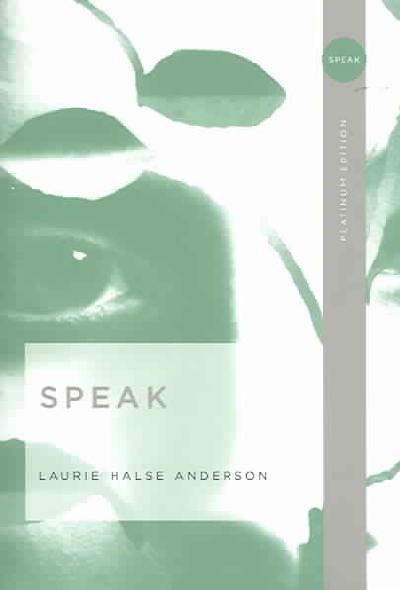
I knew about this book for too long before I bothered to read it, and I'm thoroughly annoyed with myself for not picking it up sooner. The teacher I worked with in the final year of my Education degree used this book in her remedial English classes, and I can totally see why. This book does an excellent job of presenting the challenge of high school, and doesn't hold back for fear of offending. This is a book that anyone who interacts with teenagers on a regular basis needs to read, although prepare to have your heart broken.


Although my opinion differs a bit having read the second book in Roth's trilogy, I originally thought that Divergent was perhaps better than The Hunger Games. Tris Prior falls somewhat in between Katniss and Lisbeth of The Girl With the Dragon Tattoo on the badassery scale, which I think is plenty bad enough for the teenage reader. Again, it is dystopia (as most teen lit is nowadays), but the story runs at such a fast pace that it is hard to find fault in it. I admire Roth greatly, as she happens to be a Christian, and also happens to be younger than I am. Colour me impressed. 


This may have been the funniest book I've ever read. (Lamb by Christopher Moore is shaping up to be a close second.) I vividly remember sitting in a particular chair in my house as a teenager, and laughing until I cried. I had never laughed myself to tears reading before, and I don't think I've done it since. Certainly not a book for young teens (because the British humour is probably a bit risque), but it is definitely worth reading as an adult! If you ever need consoling about how difficult your life is, start reading this series. Poor Georgia will make you feel infinitely better by comparison.


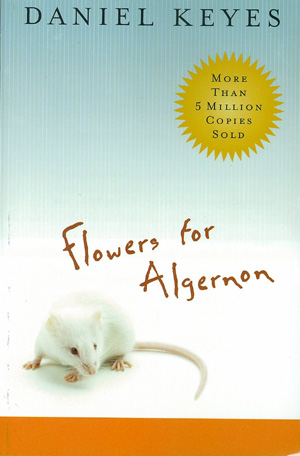
This is one of a handful of books that I've read more than once in my life, and it was a book I was required to read for school. Contrary to most books in this post, it is old. As in, was written in the late 1950s old. The book centers around a thirty-something man with a very low IQ who undergoes experimental testing to increase his IQ. The historical understanding of disability and mental illness is very accurate to the time, as well as illuminating. Teens would do well to read this book to understand how ability/disability are defined.


Another "I read it in high school but still loved it" book, written by a man who is unfortunately no longer with us. Bradbury has an excellent personal story (mostly re: his education via the public library system), and was also an excellent writer. Surprise, this book also falls under the dystopian umbrella, but is far from similar to any dystopian novels I've read. It takes place in world where firefighters are responsible for burning books (hence the title, which refers to the temperature at which books ignite). This book is undoubtedly on my ultimate top ten list.


--- chRistie

PS: Books listed = in no particular order (not even alphabetical).

The 10 Books Series - Faith Changers

After he returned from his first semester in Ottawa, my then-boyfriend/now-husband (TBNH) would not stop talking about this book. I set aside my general distaste for non-fiction and read it, only to be wildly transformed by Vanier's understanding of love. TBNH and I have parenthetical citations from another of Vanier's books engraved on our wedding rings. To be precise, they read (Vanier 298), which refers to a quote about doing ordinary things with extraordinary love. All that to say, Vanier's writing (and his work with L'Arche) made a huge impact on my life.

The Furious Longing of God - Brennan Manning
I read this book mostly while swinging in a hammock while my TBNH was at work and I was on a self-imposed vacation from substitute teaching. Biography was my first real introduction to what I felt was enjoyable non-fiction, and Brennan Manning's book was no exception. This book is such a quick read, but it is an excellent reminder that--no matter the circumstances--God loves every human being equally. I'm getting really excited to read one of Manning's other books, The Ragamuffin Gospel.

When this book was released, I had zero desire to read it. My previous experience with Christian fiction was mostly negative (case in point: the Left Behind series, which had me very confused and superimposing the series onto the Bible). My TBNH--who is one of the most critical readers I know--had read The Shack and suggested that I read it. It, quite honestly, transformed my faith entirely. The image of God at the centre of a mobile than at the top of a ladder is an image that I hold on to very tightly.

The Lord of the Rings - J.R.R. Tolkien
Tolkien was my first legitimate exposure to literature written by a Christian that wasn't Christian literature. (Contrary to most people who grew up in a Christian home, I didn't read The Chronicles of Narnia until I was in my late teens.) Tolkien not only catered to my love of fantasy literature, but made clear distinctions between good and evil, and emphasized consequences for evil, or even irresponsible, choices. He gave me hope that being a Christian and being intelligent were not mutually exclusive. If you want to get me talking, Tolkien is the best topic of conversation.

The End of Religion - Bruxy Cavey
I include this book, even though I haven't read the entire thing, because I attend The Meeting House, which Bruxy Cavey is a lead pastor of. Despite the fact that I love structure and rules, over time I've learned that following rules doesn't make you a Christian. Bruxy's biggest point? To live as followers of Jesus, the emphasis should be on a relationship (and the new covenant) rather than following a series of rules. Contrary to what many people believe, with a heart change you'll want to 'follow the rules'; rules first won't do you any good.


Sex God - Rob Bell
About halfway through my undergrad, I took a summer course about Christianity and culture. It had a 'choose your own adventure' final essay topic, so I decided to write about sex. Thus began my foray into controversial topics (no wonder I ended up marrying TBNH). Despite Bell's recent controversy, this book was a big, helpful deal for me. His writing style irked me a bit, but his ability to remind and clarify that sex isn't a dirty thing is a much-needed concept. This book sparked my curiosity (and now greater understanding) of human sexuality.

The Message - Eugene Peterson
Growing up, the only part of the Bible I found interesting was the book of Revelation. All that apocalypse stuff was super interesting to me, so I read it when I was supposed to be paying attention in church. When the complete Message translation was released (I was in high school), it blew my mind. For once, the biblical text didn't look like a totally different language to me. The Message introduced me to the practice of comparing translations, which has become and integral part of my Bible-reading process.

The Hole in Our Gospel - Richard Stearns
In the midst of what feels like a very tumultuous season of life, I decided to read this book as a part of an online book club. As it turns out, Richard Stearns' transition to president of World Vision involves the same emotions and thoughts that I am currently having. This book has been unbelievably reassuring, mostly regarding how God wants us to do things that aren't easy. Stearns provides a fairly exhaustive examination of global poverty, and how it doesn't make any sense based on the gospel to not do things.

I imagine that C.S. Lewis would fall into many top ten book lists, especially when it involves faith. As I mentioned earlier, I read The Chronicles of Narnia after I read The Lord of the Rings, and I really loved the super obvious allegory of the stories. I learned to understand the crucifixion a lot better because I compared the image of Aslan to that of Christ in The Passion of the Christ from the early 2000s. Great theological points aside, I really do love fantasy (and always have), so Lewis' series was a great treat for me.

Irresistible Revolution - Shane Claiborne
I read this book last summer along with a group of other friends for a quasi-book club, and was totally delighted with Claiborne's way of thinking and living his life. The book certainly isn't a challenging read, but the actions that Claiborne asks the reader to put into practice are a serious challenge to say the very least. I was first interested in Shane Claiborne because I read the letter he wrote to non-believers that was published in Esquire magazine. Read it if you have the chance. The man really gets it.


* Red Letter Christians - Tony Campolo
Despite the fact that I have yet to read Red Letter Christians, I'm still counting it as one of my top faith-changing books based on hearing Tony Campolo speak at various events, and on a recent conversation with him. He is one of the few Christian figures who isn't afraid to address the issues surrounding faith and politics, and does it in the most Jesus-centered way. Get this man talking about church and state, and he will yell for hours. It is wonderful.


--- chRistie

PS: Books listed = in no particular order (not even alphabetical).

The 10 Books Series

I love reading.

I assume everyone who knows me, even as an acquaintance, knows how important reading is to me. I learned to read at a very young age (I distinctly remember reading these books before attending kindergarten, if not before preschool), and I have always read--voraciously--since then.

In light of stumbling upon Sarah Bessey's 10 Books A Day For A Week series, I decided that it would be really valuable for me to do a similar reflective process. Granted, you certainly shouldn't expect a post every day or anything crazy like that; I've got books to read (and regular life to live)!

So consider yourself warned: henceforth (at least for the next month or so), all posts will likely be about books.

--- chRistie